Comparing Islamic Finance to Conventional Banking: Key Differences
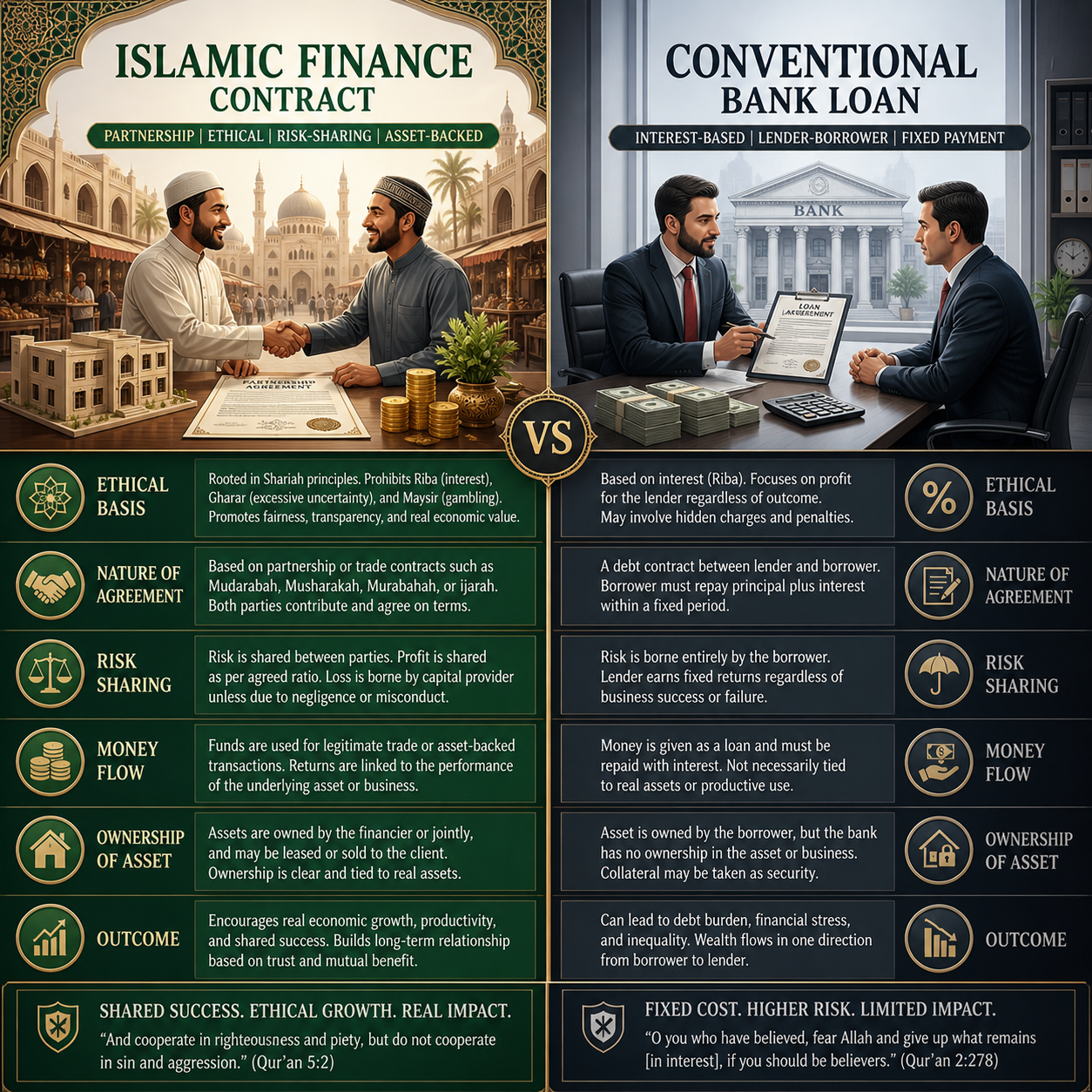
Islamic finance and conventional banking both provide payments, deposits, credit, and investment services, but they operate from different principles. Conventional banking generally earns income through interest and contractual lending, while Islamic finance follows Sharia law and structures returns through trade, leasing, partnership, and investment.
The practical difference appears in the contract behind a product. A conventional mortgage may involve lending money against interest; an Islamic home-finance product may involve a sale, lease, or shared ownership arrangement. Availability, terminology, regulatory treatment, and pricing vary by provider and jurisdiction, so customers should assess the full contract rather than rely on the product label.
What Are Islamic Finance and Conventional Banking?
Islamic finance is a financial system guided by Sharia law, while conventional banking is a lending and deposit system that commonly uses interest, debt contracts, and market-based pricing. Both can serve similar customer needs, but their permissible methods and underlying objectives differ.
Conventional banking treats money as a financial asset that can be lent for a predetermined return. Banks typically accept deposits, provide loans, process payments, and invest funds. The customer’s obligation is usually defined by principal, interest, fees, and repayment dates.
Islamic finance connects financing to identifiable economic activity. A bank may purchase and resell an asset, lease equipment, or enter a partnership with a customer. The framework generally emphasizes asset backing, transparency, lawful trade, and shared responsibility. Islamic financial institutions may also operate under review by a Sharia supervisory board or other Sharia-compliance authority, although oversight arrangements differ by country.
Neither model automatically guarantees better service or outcomes. Conventional banking may offer broad product availability and familiar documentation. Islamic finance may better suit customers who want Sharia-compliant contracts, but its structures can be more detailed and may involve additional transaction steps.
Interest, Profit, and the Role of Money
The main difference is that conventional banking commonly charges interest, while Islamic finance prohibits riba and generates returns through trade, leasing, or investment. In Islamic finance, money itself should not produce a guaranteed return merely because it was lent for time.
Riba is commonly translated as interest or an unjustified increase in a loan. Islamic finance therefore does not use a standard interest-bearing loan as its basic financing mechanism. Instead, the institution must link its income to a permissible transaction or commercial relationship.
For example, a conventional bank can lend a customer money to buy equipment and calculate interest on the outstanding balance. An Islamic bank might buy the equipment and sell it to the customer at a disclosed markup under murabaha, or lease it through ijarah. The customer still makes scheduled payments, but the legal and economic basis of the return is different.
Profit is not simply a substitute word for interest. Profit normally arises from ownership, sale, leasing, or business risk. Interest is a predetermined charge attached to the use of borrowed money. Some Islamic products can produce predictable payment schedules, yet their compliance depends on the underlying contract, asset ownership, risk allocation, and execution.
Customers should compare the total payable amount, fees, security requirements, and early-settlement terms. A Sharia-compliant product can have a cost similar to a conventional product because both providers price credit risk, administration, funding, and market conditions.
Key Financing Structures in Islamic Banking
Islamic banking uses contracts that connect financing with assets, services, or partnerships. The four structures most often discussed by customers are murabaha, ijarah, mudarabah, and musharakah.
Murabaha
Murabaha is a cost-plus sale. The financier purchases an asset, discloses its acquisition cost and markup, then sells the asset to the customer at an agreed price. Payment may be immediate or deferred through installments.
For instance, a bank could acquire a vehicle requested by a customer and resell it for a known total price payable over time. The customer receives certainty about the payment schedule, while the bank’s return comes from the sale. The structure requires genuine ownership and a valid sale, not merely a relabeled cash loan.
Ijarah
Ijarah is a lease arrangement. The financier owns an asset and grants the customer the right to use it in exchange for rental payments. Depending on the contract, ownership may remain with the financier or transfer later through a separate mechanism.
The owner generally retains responsibilities connected with ownership, while the customer is responsible for ordinary use and agreed maintenance. Exact obligations depend on the documentation and local law.
Mudarabah
Mudarabah is a profit-sharing partnership in which one party supplies capital and another manages the business. Profits are divided according to an agreed ratio, while financial losses generally affect the capital provider unless the manager caused loss through misconduct, negligence, or breach of contract.
Musharakah
Musharakah is a joint partnership in which the parties contribute capital. Profits are shared according to an agreed arrangement, while losses are normally allocated according to each party’s capital contribution. Diminishing musharakah may be used for property finance, with the customer gradually buying the financier’s ownership share.
These structures can meet needs similar to loans, leases, business finance, and mortgages. Their legal consequences differ, especially around ownership, insurance, default, maintenance, and early settlement.
Risk-Sharing Versus Risk Transfer
Islamic finance emphasizes shared commercial risk, whereas conventional lending commonly places repayment risk on the borrower through a debt obligation. The distinction is strongest in partnership contracts, although many Islamic retail products still provide fixed payment schedules and security.
With a conventional loan, the borrower normally owes principal and interest whether the financed business succeeds or fails, subject to the loan agreement and applicable law. The lender may take collateral and assess income, credit history, and debt-service capacity.
In a mudarabah or musharakah arrangement, the financier has a closer connection to the underlying venture. Returns depend on business performance, and losses may be shared under the contract. This can align the parties’ interests, but it also creates more demanding monitoring, reporting, and governance requirements.
Risk sharing does not mean that Islamic banks accept unlimited risk. They can use collateral, guarantees, credit assessment, late-payment provisions, and default remedies where permitted. Likewise, conventional banks sometimes share risk through equity investments or project finance. The comparison concerns the primary contract used for the transaction, not an absolute rule about every product.
Deposits, Investments, and Returns
Conventional deposits generally promise interest, while Islamic accounts may use safekeeping, profit-sharing, or investment arrangements. The customer must determine whether a return is guaranteed, variable, or dependent on investment performance.
A conventional savings account usually records a deposit that the bank can use within its banking activities, with interest paid according to the account terms. A fixed-term deposit may offer a specified interest rate for an agreed period. Deposit protection and withdrawal rules depend on the relevant jurisdiction.
Islamic banks may offer current accounts based on safekeeping principles, often with no promised return, or investment accounts based on mudarabah. In an investment account, the customer may share profits generated by an approved pool of assets. The return may therefore vary, and the account may carry risks that do not apply to a conventional guaranteed deposit.
Islamic investment products screen out prohibited activities and may use sukuk, property, trade finance, or equity investments. Conventional investments can include a wider range of assets, including interest-bearing securities and businesses that would not pass a Sharia screen.
Before opening an account, review whether the institution guarantees the principal, how profits are calculated, what fees apply, and how withdrawals affect returns. A higher degree of risk sharing may offer a closer connection to investment performance, but it can reduce certainty.
Ethical and Prohibited Activities
Islamic finance restricts riba, excessive uncertainty, gambling, and activities considered impermissible under Sharia principles. It also encourages transactions with identifiable assets, genuine consent, disclosure, and responsible commercial conduct.
Commonly screened activities can include businesses involving alcohol, gambling, pork-related products, and certain forms of adult entertainment. The exact screening methodology may differ among scholars, institutions, and jurisdictions. Islamic finance may also examine excessive gharar, meaning uncertainty or ambiguity, particularly where essential contract terms are unclear.
Gambling, or maysir, is generally excluded because returns depend primarily on chance rather than productive economic activity. Transactions should also avoid deception, unjust enrichment, and contractual ambiguity.
Takaful provides an Islamic approach to mutual protection. Participants contribute to a fund that supports members facing defined losses, with the arrangement structured around cooperation and risk sharing. Conventional insurance typically transfers risk to an insurer in exchange for a premium. The suitability of either arrangement depends on coverage, exclusions, claims procedures, regulation, and price.
Ethical screening does not remove ordinary business risk. A Sharia-compliant investment can lose value, and a conventional product can finance a productive and socially beneficial purpose. Customers should examine the actual assets, governance, and disclosures.
Practical Differences for Customers
Customers should compare the contract, total cost, ownership, repayment duties, and protections rather than compare interest rates alone. Islamic products may require a sale, lease, or partnership process, while conventional products usually document a direct loan or deposit.
- Pricing: Conventional finance quotes interest; Islamic finance may quote a markup, rent, profit rate, or expected profit share. Compare the total amount payable and effective fees.
- Ownership: In murabaha and ijarah, the financier may own the asset at a key stage. Ownership affects maintenance, insurance, title transfer, and repossession rights.
- Documentation: Islamic products can involve multiple agreements, including purchase, agency, lease, or promise documents. More documents may improve clarity but can increase administrative complexity.
- Late payment: Conventional contracts may add interest or fees. Islamic contracts often restrict treating late-payment charges as bank profit, with some amounts directed to charity where permitted. Local rules and contract wording control the outcome.
- Early settlement: A customer may have different rights to rebates, discounts, or settlement calculations depending on the product and jurisdiction.
- Accessibility: Conventional products are often more widely available, while Islamic options may be concentrated in particular markets or offered through specialist windows.
A useful comparison method is the TRACE checklist: Terms, Returns, Asset, Compliance, and Exit. Read the payment terms; identify how returns are generated; confirm the financed asset; check Sharia oversight and regulatory status; then examine early settlement, default, and cancellation options.
Before signing, ask whether the provider owns the asset, who bears damage or business losses, whether payments can change, how default is handled, and what customer protections apply. Independent legal or financial advice may be appropriate for a significant commitment.
Frequently Asked Questions
Is Islamic banking completely interest-free?
Islamic banking prohibits riba, but customers may still pay a profit margin, rent, service fee, or other permitted charge. The key question is whether the income arises from a valid sale, lease, service, or investment contract rather than interest on a cash loan.
How does Islamic finance make money without charging interest?
Islamic finance earns money through murabaha markups, ijarah rentals, partnership profits, service fees, and investment returns. Each product should explain the asset, activity, or risk that supports the institution’s income.
Are Islamic banking products available to non-Muslims?
Often, yes. Islamic banking products are generally offered based on contract terms rather than the customer’s religion. Availability and eligibility depend on the provider, country, documentation, and product type.
Is Islamic finance always cheaper than conventional banking?
No. Cost depends on funding conditions, credit risk, taxes, fees, administration, collateral, and the specific contract. Compare the total payable amount and customer protections instead of assuming either model is cheaper.
What is the difference between murabaha and a conventional loan?
A murabaha is a disclosed sale in which the financier buys and resells an asset at a markup. A conventional loan provides money that the borrower repays with interest. The difference concerns the transaction’s legal structure, ownership, and source of return, even when installment amounts look similar.
Choosing between Islamic finance and conventional banking starts with the product’s real obligations. Check Sharia-compliance oversight, total cost, contract terms, repayment requirements, early settlement rules, default treatment, deposit protection, and available customer remedies. A careful side-by-side review is more reliable than judging either system by its name alone.