Qard Hasan Explained: How Islamic Interest-Free Loans Work and Why They Matter
In a global financial system built almost entirely on interest, the concept of lending money without expecting any return beyond the principal sounds radical. Yet within Islamic finance, this is not an idealistic exception — it is a foundational principle with a name: Qard Hasan. Understanding it opens a window into how Islamic economics approaches debt, solidarity, and social responsibility in ways that differ fundamentally from conventional banking.
What Is Qard Hasan?
Qard Hasan is an interest-free benevolent loan in which the lender extends money to a borrower with the expectation that only the original amount will be returned — nothing more. The Arabic phrase translates roughly as "a good loan" or "a virtuous loan," and that ethical dimension is built into the definition itself.
The two parties involved are the muqrid (lender) and the mustaqrid (borrower). The lender transfers ownership of the funds to the borrower for a defined or open-ended period. The borrower is obligated to repay the exact principal — this repayment obligation is what separates Qard Hasan from charity or a gift. No profit, no premium, no markup is permitted.
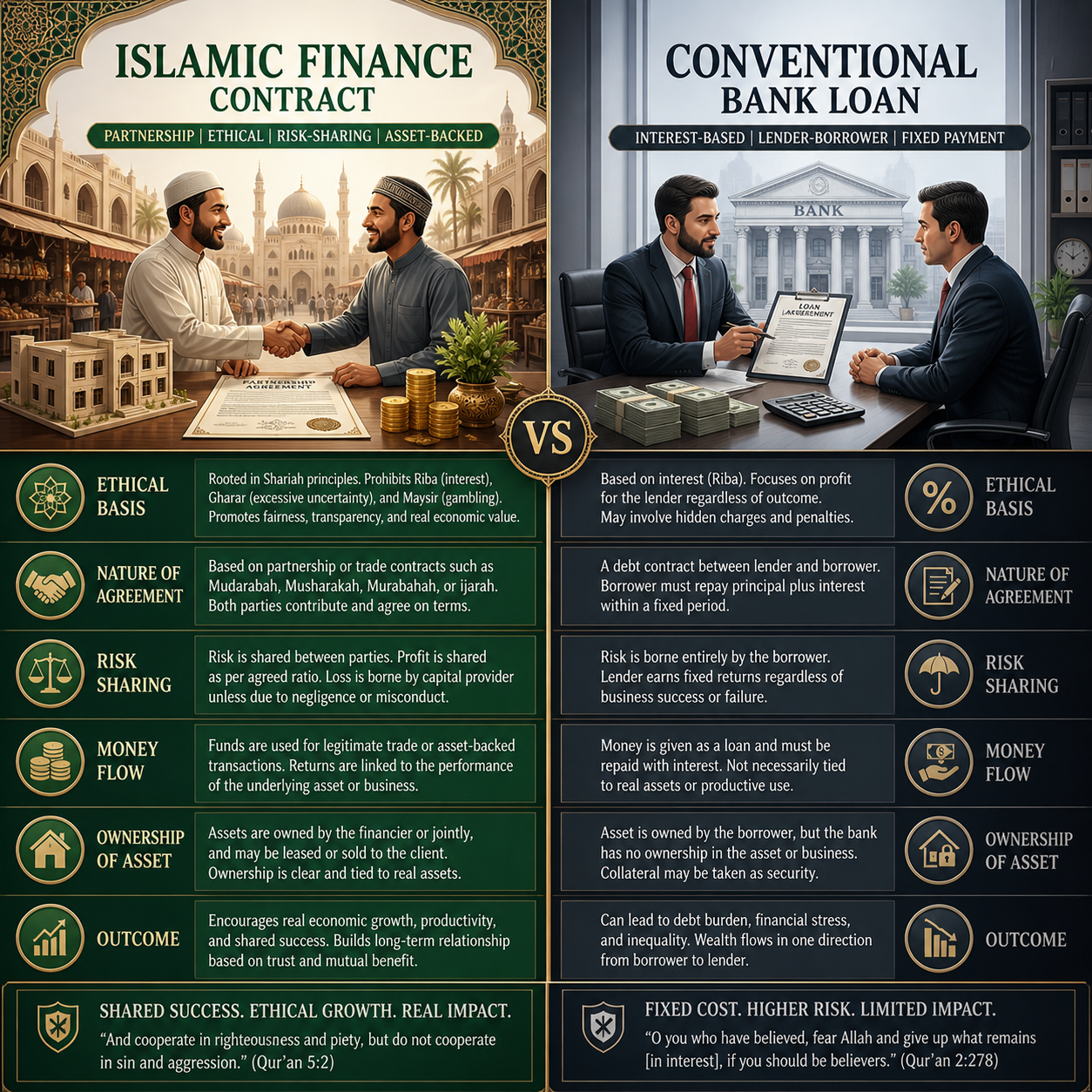
This structure sits within the broader framework of Shariah — the Islamic legal and ethical code governing all aspects of life, including financial conduct. Under Shariah, money is not a commodity that can generate returns simply by existing; it must be tied to real economic activity or genuine risk-sharing to produce a return.
The Islamic Prohibition on Riba and Its Role in Qard Hasan
Qard Hasan exists because of riba — and the absolute prohibition against it. Riba, commonly translated as "interest" or "usury," refers to any predetermined increase over the principal of a loan. It is explicitly forbidden in the Quran and Hadith, making its avoidance a religious duty rather than a preference.
The reasoning behind the prohibition is both moral and economic. Charging interest transfers wealth from borrowers to lenders without productive effort, concentrates financial power, and can trap vulnerable people in cycles of debt. Islamic scholars across centuries have viewed riba as exploitative by nature — not just by degree.
Qard Hasan is the direct response to this prohibition. Where conventional lending says "I will lend you money and you will pay me back more," Qard Hasan says "I will lend you money and you will pay me back exactly what I gave you." The lender's reward, in Islamic theology, comes from God — not from the transaction itself. This framing matters: it removes the profit motive from the act of lending and replaces it with a duty of mutual support.
How Qard Hasan Works in Practice
The mechanics of a Qard Hasan loan are straightforward, though the institutional arrangements around it can vary. A lender — whether an individual, a mosque fund, or an Islamic cooperative — agrees to provide a sum of money to a borrower in need. The terms are agreed upon: the amount, the repayment schedule, and any administrative process.
A few practical details are worth clarifying:
- No interest or profit may be stipulated by the lender. Any condition that increases the repayment amount beyond the principal invalidates the contract under Shariah.
- The borrower may voluntarily offer a gift or token of gratitude upon repayment. This is acceptable as long as it was not agreed upon in advance — the distinction between a spontaneous gesture and a contractual obligation is legally significant.
- Administrative costs (such as processing fees for institutional lenders) are debated among scholars. Some permit modest, documented cost recovery; others consider any addition impermissible. Institutions typically follow the ruling of their Shariah supervisory board.
- Repayment timelines can be flexible. Hardship extensions are not just permitted — they are encouraged. The Quran explicitly instructs creditors to grant relief to those in difficulty.
Qard Hasan vs. Other Islamic Finance Instruments
Qard Hasan occupies a unique position among Islamic finance instruments because it is the only one designed with zero financial return for the lender. This sets it apart from both conventional loans and from other Shariah-compliant structures.
Murabaha is a cost-plus financing arrangement where the financier purchases an asset and sells it to the client at a disclosed markup, payable in installments. It is widely used in home and vehicle financing. Unlike Qard Hasan, Murabaha involves a legitimate profit margin — but that profit is tied to a real trade transaction, not to the time-value of money.
Musharakah is a partnership model where two or more parties contribute capital to a venture and share profits and losses proportionally. It involves genuine risk-sharing and is used in business financing and equity structures. Again, returns are possible — but they depend on actual business outcomes, not on a guaranteed interest rate.
Qard Hasan differs from both: there is no asset sale, no partnership, no profit potential. It is purely a transfer of funds with a repayment obligation. This makes it the most ethically demanding instrument for the lender, and the most accessible for borrowers who cannot offer collateral or business plans.
Who Can Benefit from Qard Hasan?
Qard Hasan is designed primarily for people facing genuine financial hardship who need short-term liquidity without the burden of interest. In practice, the most common recipients fall into several groups.
Individuals experiencing unexpected hardship — medical emergencies, job loss, urgent home repairs — are the classic case. These are people who can repay but cannot afford to pay interest on top of the principal. A Qard Hasan loan bridges the gap without making their situation worse.
Students are another significant group. In many Muslim-majority communities and diaspora settings, interest-free student loans through Islamic cooperatives allow young people to pursue education without entering the riba-based student debt system.
Small business owners and micro-entrepreneurs, particularly those in early stages without credit history, can use Qard Hasan to cover startup costs or cash flow gaps. The absence of interest makes repayment more predictable and less punishing during slow periods.
The social welfare purpose is explicit in the instrument's design. Qard Hasan is not meant to compete with commercial finance — it is meant to serve those whom commercial finance either excludes or exploits. This alignment with Zakat (obligatory almsgiving) and the broader spirit of Islamic social solidarity is not coincidental; Qard Hasan is part of the same ethical ecosystem.
Qard Hasan in Cooperative Credit and Modern Islamic Institutions
Modern Islamic institutions have developed structured frameworks to deploy Qard Hasan at scale, moving it from individual acts of generosity to sustainable community finance systems.
Islamic credit unions and cooperative credit models pool contributions from members to create a revolving Qard Hasan fund. Members contribute regularly, and those in need can draw interest-free loans from the pool, repaying over time so the fund remains available for others. This model is active in the United Kingdom, Malaysia, the United States, and across parts of Africa and South Asia.
Waqf-backed Qard Hasan funds represent another institutional form. A Waqf is an Islamic endowment — property or assets dedicated permanently to a charitable purpose. When a Waqf endowment generates income (from rental properties, for example), that income can fund a Qard Hasan pool without depleting the principal endowment. This creates a self-sustaining source of interest-free lending capital.
Islamic microfinance institutions in countries like Bangladesh, Indonesia, and Sudan have integrated Qard Hasan alongside other instruments to reach unbanked populations. The challenge in scaling these programs is sustainability: since lenders earn nothing, the operational costs must be covered through donations, Zakat allocations, or Waqf income rather than loan returns.
Ethical and Community Dimensions of Qard Hasan
Qard Hasan is more than a financial product — it is an expression of the Takaful spirit, the Islamic principle of mutual guarantee and collective responsibility. The lender who extends a Qard Hasan loan is not making a business decision; they are fulfilling a social and spiritual duty.
This framing changes the relationship between lender and borrower. There is no adversarial dynamic, no profit extraction, no incentive to keep the borrower in debt. The muqrid wants the mustaqrid to recover and repay — not because of financial interest, but because that outcome reflects the community's wellbeing.
Trust is central to the model. Because there is no collateral requirement in many Qard Hasan arrangements and no legal profit motive for the lender, the system depends on social accountability within a community. This works well in tight-knit communities and cooperative structures; it faces challenges when scaled to anonymous institutional contexts.
The ethical dimension also extends to how lenders are instructed to behave if repayment becomes impossible. Islamic guidance is clear: if a borrower genuinely cannot repay, the lender is encouraged to forgive the debt entirely. This is considered an act of great virtue — a reminder that the loan was always an act of generosity, not a commercial transaction.
Frequently Asked Questions About Qard Hasan
Is Qard Hasan the same as a gift or charity?
No. The key difference is the repayment obligation. In a Qard Hasan loan, the borrower is expected and required to return the principal. A gift or charitable donation (like Zakat or Sadaqah) involves no repayment expectation. Qard Hasan is a loan — benevolent in spirit, but contractually binding on the borrower to repay.
Can a lender charge any fees or administrative costs under Qard Hasan?
This depends on the Shariah supervisory authority overseeing the institution. Most scholars agree that actual, documented administrative costs can be recovered — but only at cost, with no profit element. Any fee that functions as disguised interest would invalidate the contract. Individual lenders in personal arrangements are generally advised to charge nothing.
What happens if the borrower cannot repay a Qard Hasan loan?
Islamic guidance strongly encourages lenders to grant extensions to borrowers in genuine hardship. If repayment remains impossible, forgiving the debt entirely is considered a virtuous act. The lender is not permitted to impose penalties or additional charges for late repayment — doing so would introduce a riba-like element into the transaction.
Can non-Muslims participate in or benefit from Qard Hasan schemes?
There is no Shariah rule prohibiting non-Muslims from receiving Qard Hasan loans, and many Islamic scholars and institutions support extending the benefit to anyone in genuine need. Whether a specific program is open to non-Muslims depends on the policies of the institution or cooperative running it, not on a religious restriction against doing so.
How is Qard Hasan funded by Islamic institutions or cooperatives?
Funding sources include member contributions in cooperative credit models, Waqf endowment income, Zakat allocations (for eligible recipients), voluntary donations (Sadaqah), and in some cases, government or development grants. Because the instrument generates no return for the lender, sustainable Qard Hasan programs require a reliable non-commercial funding base — which is why the Waqf structure is particularly well-suited to supporting it long-term.
For readers looking to explore the broader landscape of Shariah-compliant finance, the Accounting and Auditing Organization for Islamic Financial Institutions (AAOIFI) publishes standards that govern how instruments like Qard Hasan are structured and supervised across member countries.
Qard Hasan remains one of the most distinctive and demanding concepts in Islamic finance — demanding not of the borrower, but of the lender. In a financial world that prices every risk and monetizes every service, a loan that asks nothing in return stands as a quiet but powerful statement about what money is ultimately for.