
How to Apply for an Interest-Free Loan in Islamic Banking
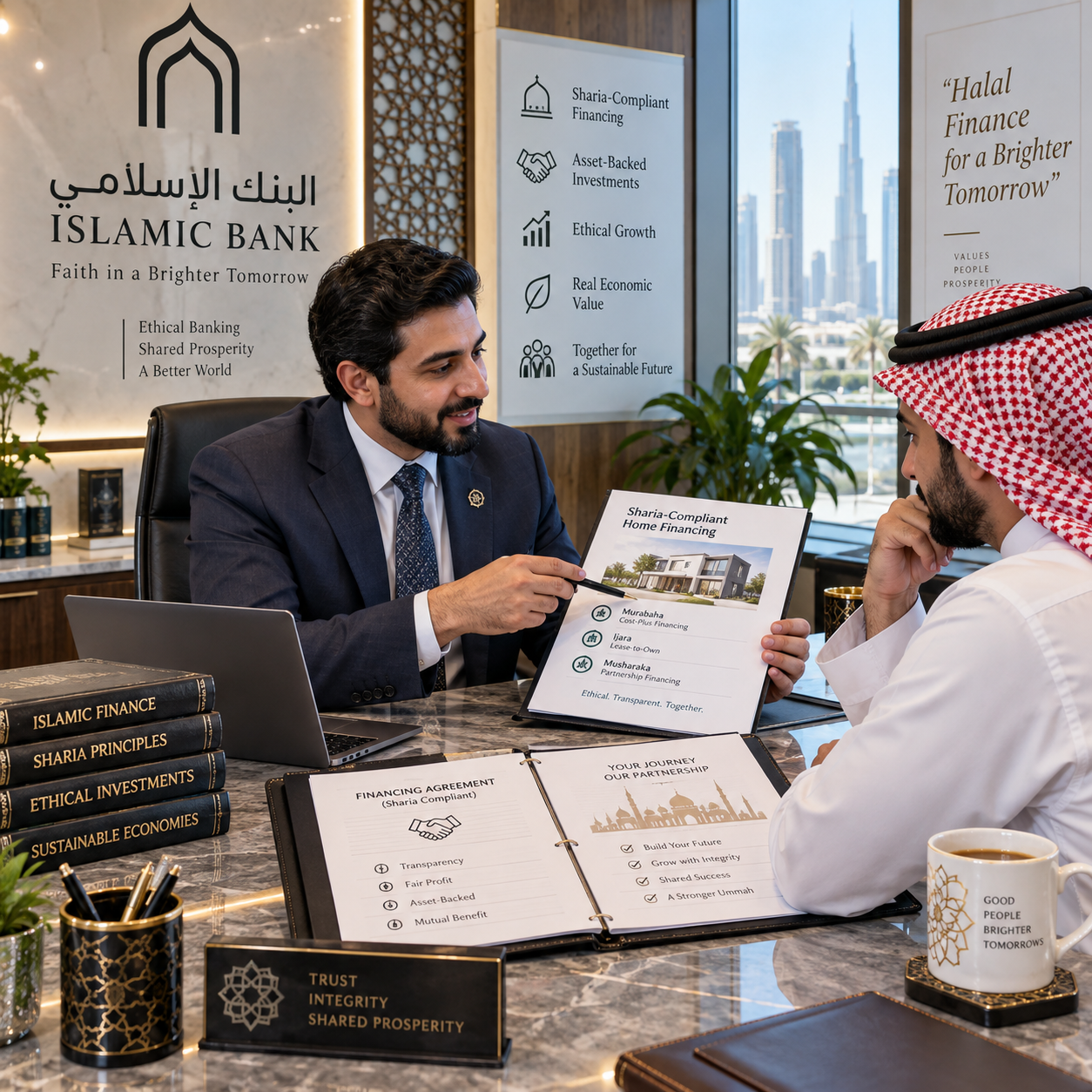
Applying for an interest-free loan through Islamic banking begins with identifying the correct Sharia-compliant structure. Some products are genuine benevolent loans, while others avoid riba through a sale, lease, or partnership and may include a disclosed profit rate.
The process usually involves checking eligibility, preparing financial documents, confirming the contract type, comparing the total amount payable, and reviewing the repayment schedule before signing. Product names, approval requirements, and legal protections vary by Islamic finance provider and jurisdiction.
What Is an Interest-Free Loan in Islamic Banking?
An interest-free loan in Islamic banking avoids riba, or interest charged on a loan, but it may use different structures with different costs. A true Qard Hasan is a benevolent, interest-free loan, while Murabaha and Ijarah are Sharia-compliant financing arrangements that can include a known profit or rental payment.
Qard Hasan generally involves lending money with an obligation to repay the principal, without a return for the lender. Islamic charities, community funds, employers, and some financial institutions may offer this arrangement for hardship support, education, medical expenses, or other approved purposes. Availability is often limited, and applicants may need to meet specific social or financial criteria.
Commercial Islamic banking commonly uses other structures:
- Murabaha: The provider buys an asset and sells it to the customer at a disclosed cost plus an agreed profit margin, with payment made immediately or over time.
- Ijarah: The provider acquires an asset and leases it to the customer for specified rental payments. Ownership may transfer later if the contract includes a separate purchase arrangement.
- Musharakah or partnership finance: The provider and customer may share ownership, contributions, profits, or risks according to the contract.
These products may be described casually as Islamic loans, although the legal transaction is often a sale, lease, or partnership rather than a conventional cash loan. Ask the provider to name the exact contract and explain how it satisfies Sharia compliance.
How Islamic Financing Differs from a Conventional Loan
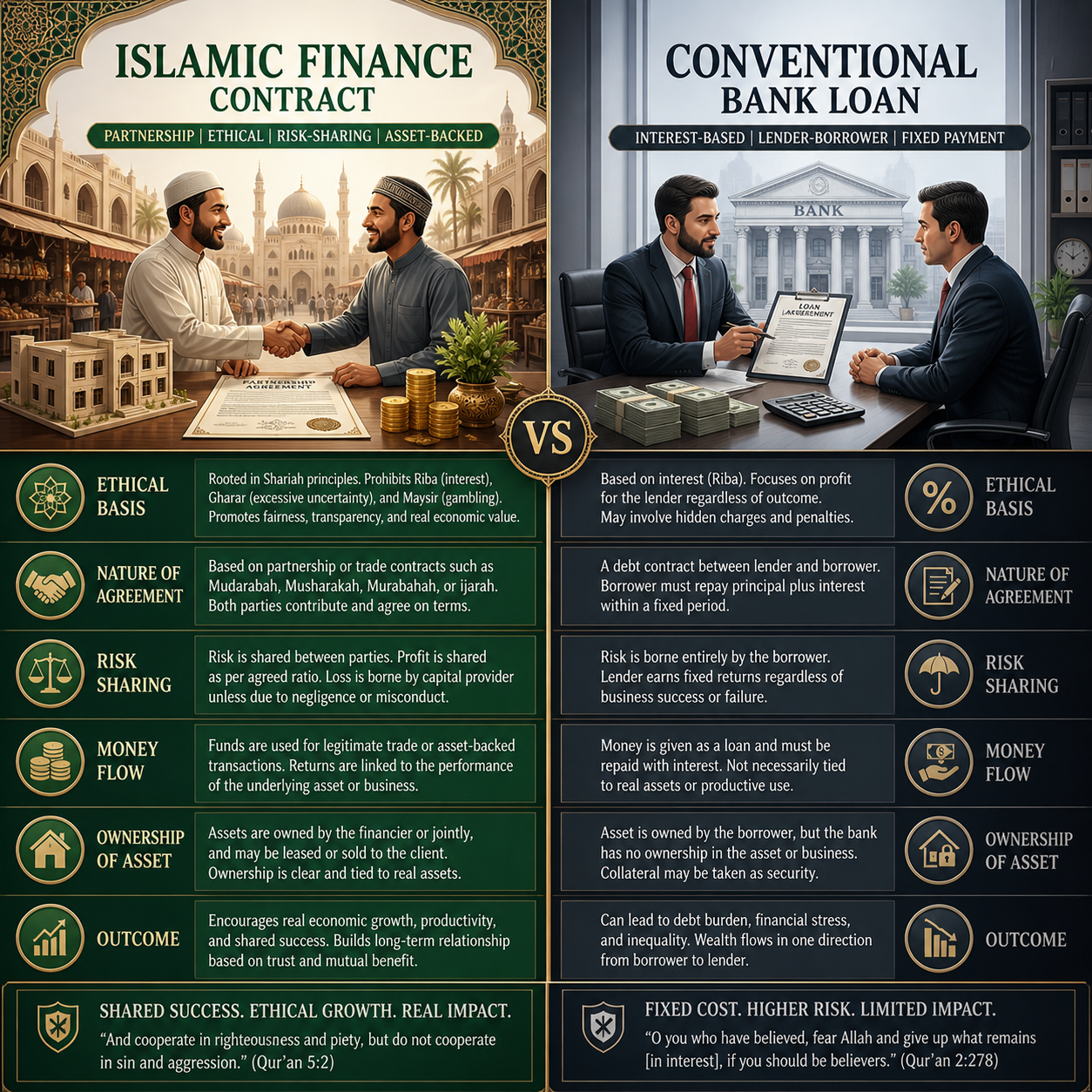
The main difference is that conventional lending charges interest on money advanced, while Islamic financing links the provider’s return to a permitted trade, lease, or investment structure. Islamic banking also prohibits riba and generally avoids excessive uncertainty, gambling, and financing for prohibited activities.
In a conventional loan, the lender provides cash and calculates interest over time. In Murabaha, the Islamic finance provider should purchase or assume ownership of an asset before selling it to the customer at a stated price. In Ijarah, the provider owns or leases an asset and receives rent for its use.
This asset connection supports the principle that money should not generate a return by itself without a transaction or risk exposure. Sharia supervision may involve an internal Sharia board, independent scholars, or a supervisory committee that reviews the product and documentation.
However, a Sharia-compliant product is not automatically cheaper. A fixed profit margin can produce a total repayment similar to, higher than, or lower than a conventional alternative, depending on the asset, term, fees, market conditions, and customer profile. Compare the total payable amount, not only the advertised profit rate.
Check Your Eligibility Before Applying
To check eligibility for Islamic financing, confirm the provider’s income, residency, credit, affordability, purpose, and asset requirements before submitting a full application. Each Islamic banking provider sets its own criteria, so preliminary approval is not guaranteed.
Common eligibility considerations include:
- Income and employment: The provider may require stable salary income, self-employment records, or evidence of regular business revenue.
- Residency and identity: Applicants normally need to live in an area served by the provider and hold acceptable identification.
- Credit history: Islamic finance providers may review credit reports and existing debts. A conventional credit history does not automatically prevent an application.
- Affordability: The provider may compare monthly obligations with verified income to assess whether the repayment schedule is manageable.
- Financing purpose: The intended purchase or use must be permissible under the provider’s Sharia policy.
- Asset suitability: Murabaha and Ijarah products may require a specific, identifiable asset that the provider can purchase, own, or lease.
Before applying, create a simple budget that includes the proposed payment, rent or mortgage, utilities, insurance, food, existing debt, and irregular expenses. Choosing a longer term can reduce each monthly payment, but it usually increases the total amount paid or extends the period of financial commitment.
Prepare the Required Documents
Most Islamic financing applications require identity, income, address, banking, and transaction-specific documents. Preparing complete records in advance can reduce delays, although the exact list depends on the product and jurisdiction.
Typical documents include:
- Passport, national identity card, or other accepted identification
- Proof of address, such as a utility bill or official correspondence
- Recent payslips, employment confirmation, or tax records
- Bank statements, often covering several recent months
- Employment details, including employer, job title, start date, and contact information
- Business accounts, invoices, tax filings, or company documents for self-employed applicants
- Information about the intended purchase, such as an invoice, quotation, property details, or vehicle specification
- Details of current debts, financial commitments, and any proposed collateral
Make sure names, addresses, income figures, and dates match across the documents. Do not alter statements or omit liabilities. Inaccurate information can cause rejection, trigger additional checks, or create problems after approval.
Step-by-Step Application Process
To apply for an interest-free loan in Islamic banking, select a suitable provider, confirm the financing structure, complete an eligibility assessment, submit documents, review the contract, and follow the provider’s approval and disbursement process.
- Research suitable providers. Check whether the institution offers Qard Hasan, Murabaha, Ijarah, or another structure that matches your purpose. Review its licensing, service area, and application channels.
- Confirm the transaction structure. Ask whether the product is a benevolent loan, asset purchase, lease, or another arrangement. Request an explanation of ownership, possession, risk, profit, and payment obligations.
- Request an initial assessment. Use the provider’s branch, website, mobile application, or telephone channel to ask about preliminary eligibility. This may involve a soft or hard credit inquiry, so ask how the assessment works.
- Submit complete documents. Upload or provide identity, income, bank, address, and asset information. Respond quickly if the provider requests clarification.
- Review the offer carefully. Check the cash price, profit amount, fees, deposit, collateral, payment frequency, repayment schedule, late-payment provisions, and early-settlement terms.
- Complete approval and disbursement. After signing, the provider may pay the seller directly, purchase the asset, transfer funds under the agreed structure, or arrange delivery and registration.
Use a written question list during the application. Ask who owns the asset at each stage, when ownership or possession transfers, and what happens if the transaction is cancelled before completion.
Understand Costs, Repayments, and Contract Terms
Before signing Islamic financing, calculate the total amount payable and understand every payment, fee, penalty provision, security requirement, and settlement rule. A transaction can be free from interest while still involving profit, rent, administration charges, or other costs.
Profit and administrative charges
Murabaha normally states the asset cost and the provider’s profit. Ijarah normally states rental payments and any purchase or transfer arrangements. Ask whether the quoted profit rate is fixed, variable, or linked to a benchmark, and request the final monetary amount rather than relying on a percentage alone.
Administrative, valuation, documentation, broker, registration, insurance, or asset-maintenance charges may apply. Some charges are legitimate costs of providing the service; others may materially change affordability. The contract and regulatory disclosures should identify them clearly.
Repayment, late payment, and early settlement
The repayment schedule should state the instalment amount, due date, number of payments, and total payable amount. Ask how missed payments are handled. Under many Islamic structures, a late-payment amount may be directed to charity rather than treated as income, but the exact treatment depends on the contract and applicable rules. Administrative recovery costs may still apply.
Early settlement can be different from a conventional loan payoff. Ask whether the provider offers a rebate, how the outstanding balance is calculated, and whether any settlement charge applies. Also confirm collateral, guarantees, insurance or takaful requirements, and the consequences of default.
A useful test is to compare three figures: the amount received or asset value, the total contractual payments, and the full cost including mandatory fees. If the provider avoids giving these figures in writing, pause before proceeding.
How to Choose a Sharia-Compliant Provider
Choose a Sharia-compliant provider by verifying its licensing, contract structure, Sharia oversight, complete pricing disclosure, complaints process, and suitability for your financial and religious requirements.
- Verify regulation: Confirm that the institution is authorised in the relevant jurisdiction and that you know which consumer protections apply.
- Review Sharia oversight: Look for information about the Sharia board or scholars who approve and monitor the product. A label alone is not enough.
- Request the contract early: Read the sale, lease, agency, security, and payment documents before making a non-refundable commitment.
- Compare total costs: Obtain written details of profit, rental payments, fees, deposits, insurance, late-payment treatment, and early settlement.
- Check the complaint route: Understand how to escalate disputes to the provider, regulator, ombudsman, or relevant Sharia review channel.
- Match the product to your purpose: A Qard Hasan facility may suit a hardship need, while Murabaha or Ijarah may be designed for a defined purchase or asset.
Be cautious of advertisements promising guaranteed approval, zero costs, or instant Sharia-compliant cash without explaining the underlying transaction. A provider that pressures you to sign quickly or refuses to disclose the contract deserves further scrutiny.
Frequently Asked Questions
Is every Islamic loan completely free of additional charges?
No. Qard Hasan is designed to return the principal without interest, but Islamic financing products may include a disclosed profit, rent, administration fee, valuation cost, or other charge. Review the total payable amount.
What is the difference between Qard Hasan and Murabaha financing?
Qard Hasan is a benevolent loan in which the borrower generally repays the principal. Murabaha is a cost-plus sale in which the provider buys an asset and sells it for an agreed price that includes profit, usually payable over time.
Can someone with a conventional credit history apply for Islamic financing?
Yes. Islamic finance providers commonly assess credit history, income, affordability, and repayment behaviour. Having conventional credit does not by itself make someone ineligible, although the provider may apply its own risk criteria.
What documents are usually needed for an application?
Applicants commonly need identification, proof of address, income evidence, bank statements, employment or business details, existing-debt information, and documents describing the intended asset or purchase.
How can applicants verify that a provider is Sharia-compliant?
Ask for the exact contract, the provider’s Sharia governance information, licensing details, pricing disclosures, and complaints procedure. You may also seek independent advice from a qualified Islamic finance scholar or lawyer in your jurisdiction.
An interest-free loan application should be treated as both a financial decision and a contract review. Confirm the structure, test affordability, compare total costs, and obtain clear answers before signing. That approach protects your finances while helping you choose financing that genuinely matches your understanding of Islamic banking.