
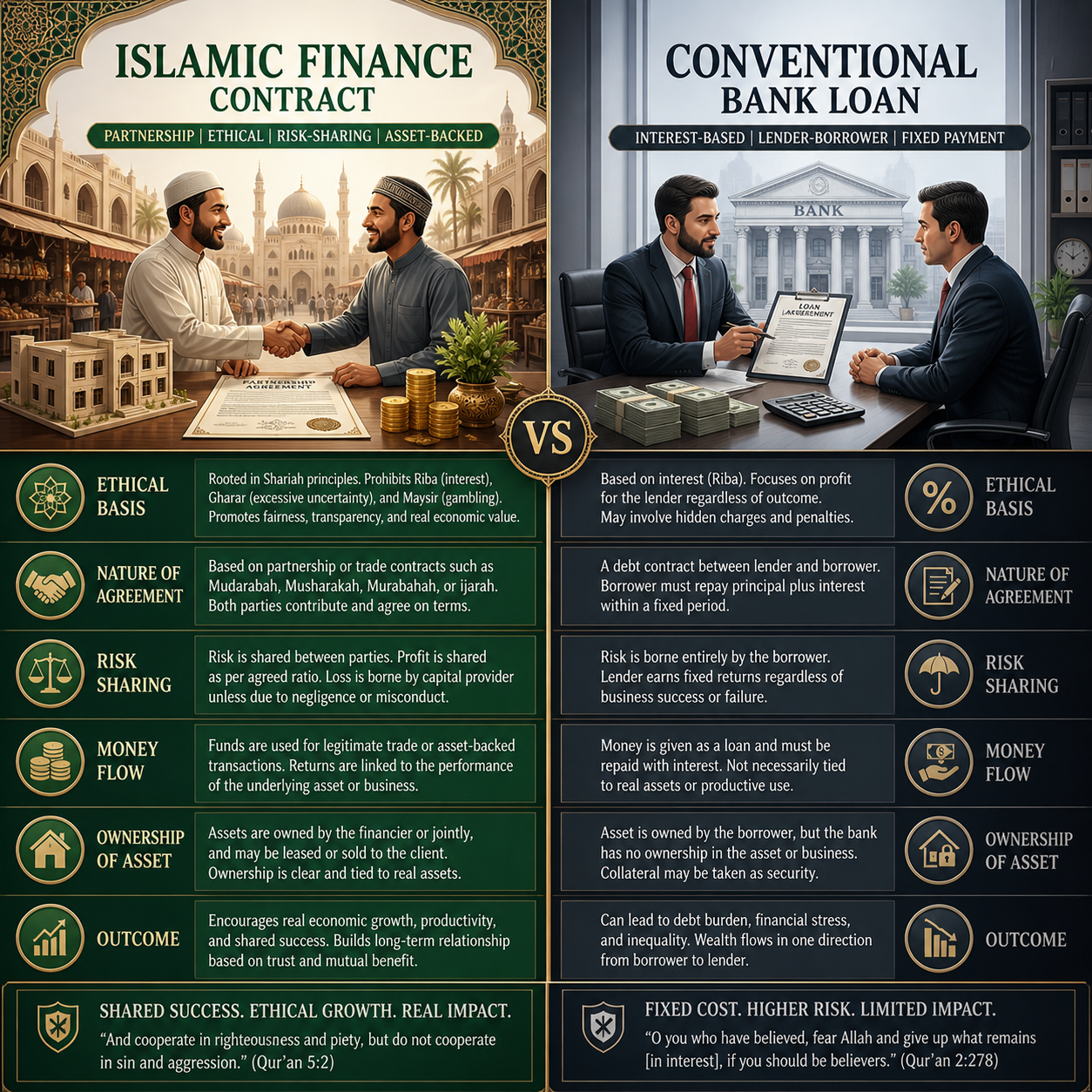
The Concept of Riba and Its Prohibition in Islam

Riba is a central concept in Islamic finance and credit. It generally refers to a prohibited increase connected to certain loans or exchanges, though scholars discuss its precise scope and application in different ways. Understanding the concept helps Muslims assess borrowing, savings, trade, and financial products without assuming that every profit or fee is automatically forbidden.
What Does Riba Mean?
Riba is an Arabic term commonly translated as usury or interest, and in Islamic finance it describes forms of excess or increase prohibited by Islamic law. Its meaning depends on the type of transaction, so evaluating a contract requires more than checking whether it uses the word interest.
The Qur’an condemns riba and distinguishes it from trade. The Sunnah, including reports about exchanges of particular commodities, also informs how jurists identify prohibited increases. Across Islamic legal schools and contemporary scholarship, there is broad agreement that riba is prohibited, while some details of modern application and contract analysis can differ.
In practical terms, the issue often arises when a lender requires a borrower to repay more than the principal because time has passed. Islamic finance therefore examines the contract’s substance: what is being exchanged, who owns an asset, how payment is calculated, and which party bears risk. A label alone cannot settle the question.
Why Is Riba Prohibited in Islam?
Riba is prohibited because the Qur’an and Sunnah establish a religious rule against it, and Islamic scholars also discuss its economic and ethical consequences. The prohibition is not based on a single explanation or a claim that every interest rate has the same social effect.
The Qur’an contrasts riba with trade and instructs believers to give up outstanding riba when they accept the prohibition, while allowing them to retain their principal. The passage is often understood to protect borrowers from an unjustified increase and to affirm that ordinary commercial exchange remains possible. The Sunnah adds guidance on specific exchange transactions and helps shape the legal categories used by scholars.
Ethical discussions commonly focus on fairness, responsibility, and the relationship between return and risk. A guaranteed return on a loan may place the repayment burden on the borrower even when the financed activity performs poorly. By contrast, trade or investment can involve ownership, effort, market uncertainty, and the possibility of loss. These considerations help explain the system, but they do not replace the textual basis of the prohibition.
Muslim scholars may differ over how a modern product fits the relevant rules. For a personal decision, it is sensible to consult a qualified scholar or Islamic finance adviser who can examine the actual terms rather than issue a ruling from a product name alone.
Main Forms of Riba
Islamic finance discussions commonly identify riba al-nasi’ah, associated with deferment or time-based increase, and riba al-fadl, associated with unequal exchange of certain like-for-like goods. The categories are useful guides, although their detailed application depends on the transaction and scholarly interpretation.
Riba al-nasi’ah
Riba al-nasi’ah is often explained as an increase tied to postponing payment or extending a debt. A familiar example is a loan of 1,000 units of currency that requires repayment of 1,100 solely because of the loan and the passage of time. Contemporary scholars commonly apply this concern to interest-bearing loans, while the precise analysis of a particular agreement still depends on its structure and context.
Riba al-fadl
Riba al-fadl concerns certain exchanges in which specified commodities of the same type are traded in unequal quantities or under prohibited conditions. Classical discussions often refer to gold, silver, and staple food commodities described in hadith. These rules aim to prevent an exchange from disguising a prohibited gain as a straightforward barter transaction.
These labels do not mean that every delayed sale or unequal price is riba. A sale of an asset at an agreed price with payment later is distinct in form from a loan that accrues an increase, though the specific contract must be reviewed. Scholars also differ in how they identify the relevant categories and apply them to modern assets and currencies.
Riba, Trade, and Profit
Profit is not automatically riba: Islamic law permits returns from trade and investment when the transaction meets its rules. The key distinction is whether a return comes from a valid sale, lease, or investment arrangement, or from a prohibited increase on a loan.
In a sale, a seller transfers an asset for an agreed price. The price may be higher for deferred payment than for immediate payment in some scholarly approaches, provided the parties settle on one clear price and the contract avoids prohibited conditions. In a lease, rent is paid for the use of an asset. In an investment partnership, returns may be linked to business performance, and the parties’ rights and responsibilities depend on the agreed structure.
Profit and risk-sharing are often highlighted in Islamic finance because they connect financial return to commercial activity. That does not mean every compliant arrangement must share risk in exactly the same way, or that a transaction is permissible simply because it includes some risk. Ownership, possession, disclosure, and the allocation of liability all matter.
A useful test is to ask: What generates the return? If it arises from selling or leasing an asset, or from investing under a valid arrangement, that points to a different analysis than a fixed increase owed solely for lending money. The distinction is a starting point, not a substitute for reviewing contract terms.
Riba in Modern Credit and Finance
Riba questions arise in mortgages, personal loans, credit cards, savings accounts, and business finance. A product’s legal and religious assessment depends on its contract, fee structure, and operation, so two products with similar marketing may require different analysis.
Conventional interest-bearing loans generally raise the central concern because repayment includes an increase linked to the amount borrowed and time. Credit cards can involve interest when a balance is carried, as well as fees that may need separate review. Savings products may promise a fixed return on deposited funds, but account structures vary and should not be judged from the advertised rate alone.
Islamic finance providers may offer alternatives such as murabaha (a cost-plus sale), ijara (a lease), or partnership-based financing. These structures can provide practical access to credit or assets, but their compliance depends on how they are implemented. For example, a sale-based home finance plan should clearly identify the asset, purchase and resale steps, price, ownership responsibilities, and consequences of late payment.
Some products marketed as Sharia-compliant may still prompt questions about documentation, risk allocation, or fees. Compare the complete agreement, not just the monthly payment or the provider’s label. Sharia-compliant credit may also cost more or offer fewer choices in a given market; those trade-offs deserve careful comparison alongside religious and financial considerations.
How to Assess a Sharia-Compliant Alternative
To assess a Sharia-compliant credit alternative, review the contract’s substance, identify how the provider earns its return, and ask a qualified adviser about any unclear terms. This practical check can help you compare products without treating a marketing claim as a religious ruling.
- Identify the contract. Is the arrangement a loan, sale, lease, or investment partnership? Ask which asset or service is involved and when ownership transfers.
- Trace the payment. Separate principal, sale price or rent, administrative fees, and late-payment charges. Find out whether any charge increases because the debt remains unpaid and how that amount is handled.
- Check responsibility and risk. Ask who bears loss if an asset is damaged before delivery, who pays for maintenance, and what happens if the transaction ends early. Contractual responsibilities should match the stated structure.
- Read the full documents. Review the offer, schedule of charges, default terms, and early-settlement conditions. Request written explanations for clauses you do not understand.
- Seek qualified review. Ask a scholar or Islamic finance professional familiar with the product type to assess the documents. For a large commitment, compare more than one provider and consider independent advice.
Useful questions include: Has a recognized Sharia supervisory board reviewed this product? Does the provider own or assume responsibility for the asset where the contract requires it? Are fees fixed and disclosed? What happens after a missed payment? A clear answer to each question is more useful than a broad claim that a product is simply Islamic.
Frequently Asked Questions
Is riba the same as interest?
Many contemporary scholars treat conventional interest on loans as riba, but the terms are not interchangeable in every discussion. Riba is the wider Islamic legal category, and the contract’s structure determines how scholars apply it.
Is every kind of profit prohibited?
No. Profit from permissible trade, leasing, or investment can be allowed when the transaction meets Islamic legal requirements. The source and terms of the return matter.
What are riba al-nasi’ah and riba al-fadl?
Riba al-nasi’ah is commonly associated with an increase linked to deferred payment or a debt’s duration. Riba al-fadl concerns prohibited excess or conditions in exchanges of certain like-for-like commodities.
How can I evaluate whether a credit product is Sharia-compliant?
Read the complete contract, trace the source of every charge and return, check ownership and risk responsibilities, and ask a qualified scholar or Islamic finance adviser to review the specific documents.